Stop Door Barking: Calm Knock-to-Mat Training Plan
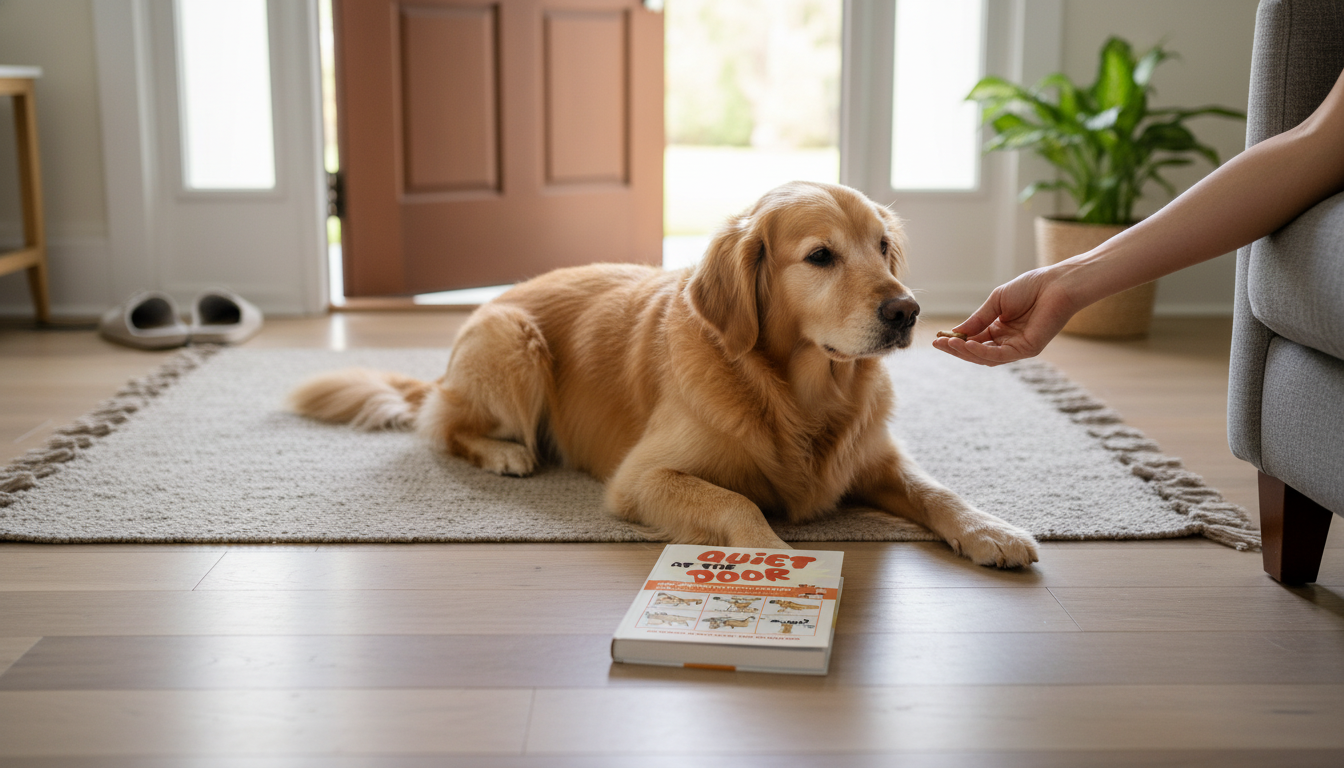
Quiet at the Door: A Practical Plan to Stop Barking at Strangers
Doorway barking is one of the most common (and stressful) household challenges: the knock, the bell, a person on the porch—and suddenly the home turns into high alert. The most effective solutions combine management (so the behavior can’t rehearse), skill-building (what to do instead of barking), and calm, repeatable practice sessions that feel predictable to the dog.
Why dogs bark at the door
Barking at strangers isn’t “random”—it’s usually a pattern that has paid off for the dog in the past.
- Territorial alarm: the dog believes barking makes strangers go away (and it often does).
- Startle response: sudden sounds and movement spike arousal before thinking kicks in.
- Barrier frustration: the dog wants to approach but can’t, so barking escalates.
- Learned routine: the household rushes to the door, voices rise, and barking becomes part of the event.
- Undertrained replacement behaviors: the dog has no clear job when the door activity starts.
Set up the environment so practice is possible
Before training changes behavior, management prevents the behavior from getting stronger. The goal is simple: reduce intensity and create a repeatable setup.
- Use distance: keep the dog behind a baby gate, in a crate, or on a leash before opening the door.
- Reduce triggers: close blinds facing the porch; add a white-noise machine if hallway sounds set the dog off.
- Stage a “landing zone”: place a mat/bed away from the door where the dog can settle.
- Prepare high-value treats: keep them near the entry so rewards are immediate.
- Choose a household script: decide who answers and who handles the dog to prevent chaos.
Teach the core skills away from the door first
If the door is already a “big deal,” build fluency in calm behaviors somewhere easier (living room, hallway, backyard). Then bring those skills to the entryway.
- Name recognition and check-ins: reward quick eye contact when the dog hears their name.
- Hand target (“touch”): a simple way to redirect the dog’s body and attention without pulling.
- Settle on a mat: reward for stepping onto the mat, then lying down, then relaxing longer.
- Quiet marker: reward brief pauses in barking (start with 1 second of silence) and gradually extend.
- Leash manners indoors: practice walking to the mat calmly so the dog has a clear route and job.
For general barking guidance and humane training principles, these references are helpful: American Kennel Club and the ASPCA.
A step-by-step door training routine (knock → calm → reward)
This routine teaches the dog that door sounds predict calm, structured reinforcement—not a frantic chase to the threshold.
- Start small: use a helper and a low-intensity trigger (soft knock or a doorbell sound played quietly).
- Before the knock: cue the dog to the mat; reward for getting on it.
- Knock happens: helper knocks once; immediately feed several small treats in a steady rhythm while the dog stays on the mat.
- If barking starts: increase distance or lower intensity; avoid opening the door during barking.
- Keep it short: repeat 3–5 minutes, then stop while the dog is still successful.
- Gradually add difficulty: louder knock, door handle jiggle, door opening a crack, then the helper stepping in.
- Add a release cue: use “okay” only after calm behavior is reliable so greeting becomes a privilege, not a surge.
Progression checklist for door practice
| Step | Trigger level | Dog’s job | Success looks like |
|---|---|---|---|
| 1 | Quiet knock (1 time) | Go to mat, take treats | 1–3 seconds calm with minimal vocalization |
| 2 | Normal knock / bell sound low volume | Stay on mat while handler feeds | Quick recovery after startle |
| 3 | Door handle movement + knock | Mat stay, then hand target | No lunging; barking decreases in duration |
| 4 | Door opens a crack | Mat stay while door moves | Dog remains behind boundary |
| 5 | Visitor steps in briefly | Mat stay, optional calm greeting on cue | Quiet body, loose posture, can disengage |
What to do during real-life door moments
Real life is messier than practice. The priority is preventing rehearsal and keeping everyone safe, then returning to training when you can control the setup.
Common mistakes that slow progress
When extra help is needed
A ready-to-follow training plan
If you want a structured sequence of exercises, scripts, and practice scenarios, Quiet at the Door: The Ultimate Guide to Stopping Barking at Strangers at the Door lays out a step-by-step path from basic skills to realistic visitor setups.
For households that benefit from consistent scripts and calmer communication during high-energy moments, Positive Parenting Tips Guide | Gentle Parenting eBook | Empathic Communication | Digital Download for Moms & Dads can help reinforce predictable routines and reduce “everyone talks at once” door chaos that often fuels barking.
FAQ
How long does it take to stop barking at the door?
Expect weeks, not days. Many dogs improve by barking for a shorter time and recovering faster before they become consistently quiet, and the timeline depends on baseline reactivity plus how often you practice.
Should barking at strangers at the door be punished?
Punishment often raises fear and arousal, which can worsen reactivity and make the door feel even more threatening. Safer, more effective options are management (distance and barriers) and rewarding quiet or alternative behaviors; get professional help if aggression is present.
What if my dog won’t take treats when someone knocks?
That usually means the trigger is too intense and your dog is over threshold. Increase distance, lower the volume/impact of the knock, and use higher-value rewards while starting with very mild door sounds; if it remains severe, enlist a qualified trainer.









Leave a comment